
Thoughtwalking
Why?
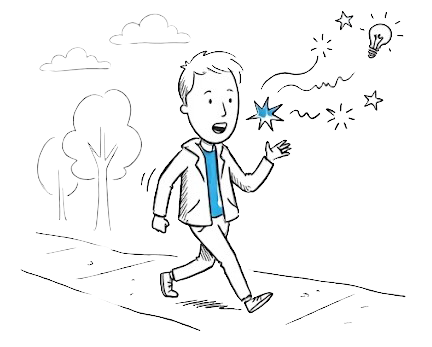
Generate and develop new ideas by combining physical movement, thinking aloud and the active use of research insights to explore potential design directions.
How?
Take a walk outside or in another environment away from your usual workspace. While walking, think aloud about the design challenge, explore possibilities and make unexpected connections. Revisit relevant research findings, user needs and project constraints to guide your thinking without immediately judging each idea. Capture promising thoughts through voice notes or write them down immediately after the walk. Review and develop the ideas further at your workspace.
Ingrediënts
- A clearly defined design challenge.
- A suitable environment where you can walk.
- A willingness to think aloud, explore associations and follow unexpected lines of thought.
- A way to capture ideas during or immediately after the walk.
- An open mindset that prioritises generating ideas over evaluating them.
In practice
Thoughtwalking can be used individually when a designer feels creatively stuck, wants to explore out of the box ideas or needs to develop initial concept directions. Walking has been associated with improved performance in divergent-thinking tasks, which involve generating multiple ideas. The ideas generated can be organised, evaluated and developed further at the workspace.
- Thabane, A. et al. (2026). The impact of walking on creative thinking: A systematic review and meta-analysis. PLOS ONE. A systematic review and meta-analysis of 23 studies examining the effects of walking on creative thinking. https://doi.org/10.1371/journal.pone.0347878
- Oppezzo, M. & Schwartz, D. L. (2014). Give Your Ideas Some Legs: The Positive Effect of Walking on Creative Thinking. Journal of Experimental Psychology: Learning, Memory, and Cognition, 40(4), 1142–1152. Experimental research investigating the effects of walking on creative idea generation. https://doi.org/10.1037/a0036577
- Glogger-Frey, I. et al. (2024). Coherence building while reading multiple complementary documents. Contemporary Educational Psychology, 77, 102266. Research comparing self-explanation with thinking aloud, finding that self-explanation instructions produced more cohesive responses. Relevant to verbalising and organising thoughts, although the study focused on learning rather than creative ideation. https://doi.org/10.1016/j.cedpsych.2024.102266
- Fox, M. C., Ericsson, K. A. & Best, R. (2011). Do Procedures for Verbal Reporting of Thinking Have to Be Reactive? A Meta-Analysis and Recommendations for Best Reporting Methods. Psychological Bulletin, 137(2), 316–344. A meta-analysis examining whether verbalising thoughts changes cognitive performance. Useful methodological background for thinking aloud, but not direct evidence that it improves creativity. https://doi.org/10.1037/a0021663
- Ericsson, K. A. & Simon, H. A. (1980). Verbal Reports as Data. Psychological Review, 87(3), 215–251. A foundational paper on using verbal reports to study people's thought processes. https://doi.org/10.1037/0033-295X.87.3.215